|
|
 |
Case Studies
XPERTTRAILS– BROWSING MANAGEMENT SYSTEM
Location: US
Industry: Technology
Technology: XML/Oracle
Domain: Web
XpertTrails is a knowledge management search solution that tracks the activities of users. This application was developed for US based client. It is an enhanced browser feature that acts as an alternative to a search engine. This software lets users create their own ‘pathway’ through the Internet jungle, which can be shared with others. Browser information (URL) captured from one browser can be sent to any other browser. This user-friendly system automatically records the sequence of URLs that users visit while surfing the Internet. Users can then go back and edit, delete or reorder the URLs to create an own custom trail. Trails created can be e-mailed to friends or colleagues, or posted to the XpertTrails library - making them accessible to the public.
With XpertTrails, the user can become an expert on topics that the user is interested in, and can formulate the best paths to finding relevant information on the Internet. XpertTrails gives the user the necessary control to access the path to information about a topic. By recording, editing and reordering the URLs that have been accessed, the user can determine the best trail for others to follow in their quest for information. There are several trail types such as private, public and corporate trails. The private trails of corporate entities are stored with individual corporate clients within their own system. When one corporate wants to share the data with another company, the data is converted into XML schema, saved in XML format, transferred to the second corporate (who wishes to buy the trail) and ultimately converted into second party format. The XML.DOM is used here for caching the data. Many user-defined & trail data have been formatted into a DOM object and cached into the application at the server. This increases the speed of the data access.
This application is a Java-based n-tier architecture that works on both Internet Explorer and Netscape Navigator browsers, in Windows or Linux platforms. The site was developed on Apache1.2 web server. A patch (customized solution) from Tomcat was used to handle a JSP-related bug on Apache.
Technology
Servlets, HTML, XML, Applets, Java Script, Apache1.2, Oracle 8.i, JSP, Tomcat, Linux (Red Hat 6.2, Gnome), JBuilder3.5
Betting Management System
Location: UK
Industry: Betting/Gaming
Technology: Microsoft
Domain: Client/Server
(A) Telebets
Technology : Visual Basic 5.0, SQL Server 6.5, ASP, XML, Windows NT
Description :
This application consists of two modules –
1. Bets Scroller
2. Business Summary
The main application is an online system, through which several users of the system, called clients, can strike their bets on various sports like horse racing, football, tennis, etc.
The aforementioned modules present the bets struck by various clients, in the format required by the betting house. Clients can view the events and the bets struck on various events, simultaneously and instantaneously. Clients can define their filters for the bet details to be displayed.
Details presented by the application include - Betting Event, Client Name, the Largest Stake Amount, the Maximum Returns as on Date, and the Event on which the client got Maximum Returns.
An important feature that the system offers is automatic refresh facility for displaying the new bets struck on the system. When the registry configured time interval is reached, the system will automatically refresh the display screen and show the new bets struck, based on the criteria selected by the user.
(B) Betting Shop – 2000
Technology : VB, SQL Server 7.0, COM/DCOM, Win32 API Programming
Scope : Enhancement and Maintenance
Description :
The BS2000 is a 3-tier Client-Server application developed to be used in leading betting centres across the UK. The complete application, while deployed, consists of 6 Server applications, running continuously, controlling 5 to 6 client machines (tills) that act as the acceptance points for bets. This complete set-up will act as a Bet Capturing Shop at race-courses and other centres where betting activities are conducted.
The Bet Capture is done while the user passes a Marked Bet Coupon (slip) through a scanner, and the application reads the marks and gives out a printed receipt. The application is synchronized with a Bet Results processing application that shares the same database with this application. This enables the application to process the cash status of each slip that is taken at the betting shop.
To make this whole set up work in synchronization, the application makes use of Distributed Component Architecture to handle messages, fail-overs and centralized logging. Win 32 API Programming is extensively used for activities like capturing and processing the scanner info, writing system logs and message handling.
(C) Bet Settler
Technology : Visual Basic 6.0, SQL Server 7.0, MSMQ, COM, DCOM, Windows NT
Description :
This project is being developed for a UK based betting house. Settler is a crucial element of an online betting system, which takes care of the settling the bets captured through a Point-Of-Sale system. This comprises of four major modules namely - Pre-Settlement, Markup, Settlement and Post-Settlement, interacting with each other via MSMQ. Pre-Settlement does the work of formatting the input bet for use by the Markup module.
The Markup module, the most complicated of the Settler modules, takes input from two sources asynchronously - one from MSMQ to which messages are sent from Pre-Settlement and the other via Satellite. This module receives various messages from Satellite and determines if the bet is a winner or a loser; and this module also handles various other functionalities like providing Liability Warning, etc. Once Markup finishes with its processing it writes out the bet to MSMQ. Settlement receives the message from Markup and it determines the price amount that is due to be paid for the bet after which, it writes out the bet to the Queue. Post-Settlement gets the message from the Queue and saves it to SQL Server database.
(D) Betting Application - Sundries
Technology : Visual Basic 6.0, SQL Server 7.0, MSMQ, COM, DCOM, Windows NT
Description :
Sundries consisted of a set of Components of an existing betting application that were to be enhanced, as well as development of a new component called AutoCapture.
AutoCapture is an ActiveX exe, asynchronous, server component that does the functionality of saving a captured bet to database. This executes on the server asynchronously waiting for captured slips, which would be saved to the MS SQL Server database. The slip, which consists of the bet details, would be scanned in at the client machine, then the scanned data would be sent to a server component through DCOM. This server component in turn sends the slip to AutoCapture, which would save it to database.
CLINICAL KNOWLEDGE MANAGEMENT SYSTEM
Location: US
Industry: Healthcare
Technology: Microsoft
Domain: Data Warehousing
The Clinical Knowledge Management System is an OLAP (On Line Analytical Processing) based project for a biotechnology research institute based in the US. This clinical management portal offered data to subscribers for analysis of clinical data from various regions of the US.
The concept of Clinical Knowledge Management (CKM) is based upon the integration of data from disparate sources and systems into a coherent, unified healthcare data warehouse. The core of the CKM approach is a robust business intelligence application that rests upon the integrated data warehouse - called the Medical Management System (MMS).
The client has an existing product called Medical Management System (MMS), which is a VFP based OLAP product with Oracle/MS SQL Server as its backend. The project involves migrating MMS from client server to web based .NET framework, which would be known as CKM. The CKM product would be based on MS SQL Server 2000 Analysis Services with backend being either MS SQL Server or Teradata and the front end being ASP.NET.
This particular project is different from the traditional transaction (OLTP) based projects. It involves complex data analysis, reporting and graphing - that takes data from a data warehouse, create cubes and query them effectively for analysis & reporting
The web site was hosted in a central location and offered corporate memberships for clinical research. The portal provided various analysis tools using graphical representations and drill down facilities. The major functionality of the portal is as listed below:
 Extracting and Scrubbing Data: The data for the portal was collected from various member hospitals that would push the data in a pre defined format to a central location. The data that is in XML format would be processed to cleanse the data and arrange in a format that the portal expects it to be in. Extracting and Scrubbing Data: The data for the portal was collected from various member hospitals that would push the data in a pre defined format to a central location. The data that is in XML format would be processed to cleanse the data and arrange in a format that the portal expects it to be in.
Anonymization: The data also needs to be anonymized to meet regulations set by the US Government. Data - such as name and exact address, is removed and replaced by a unique number; this unique number is used for all analysis purposes and also this number is stored in the database against the name and exact address of the patient (name and exact address is encrypted) - so as to enable the portal to recognize the data for the same patient for future data. There is also a requirement to maintain and display the postcode for the patient to achieve regional profiling – this is done by encrypting the postcode by assigning a hash number.
Graphical Analysis: The portal had a third party component built-in, so that users could convert the data they have retrieved on given a criteria into multi-series, multi-dimensional graphs for their analysis. The graphical reports also enable users to drill down to lower levels from aggregate data to display details.
Report Building: The portal allows users to arrange data they have retrieved into a printable format as desired. This would be converted into a PDF document for easy handling of the reports.
Personalization: The portal enables the users to customize the look and feel of the web site to match their corporate intranet.
Authentication: The web site employed very strict authentication mechanism. Each user who needs to log in to the portal to access the data is issued a secure token, which is a hardware device of the size of a key chain that dynamically changes passwords every 60 seconds. The user has to use the user id, the secure token id and a 4-digit number that is pre-selected by the user to be allowed entry into the web site.
Security: The portal is deployed over 128-bit secure socket layer that encrypts the transmission of data over the Internet, and strong encryption was employed on the database side to secure sensitive data. The system also offers very granular level control of data – the administrator can specify user’s access to particular data.
Technologies Used:
ASP.NET, VB.NET (for dynamic link libraries), HTML, DHTML, Flash MX, ADO MD, DSO, PivotTable Service, MS SQL Server 2000 Analysis Services
CONSTRUCTION PROCESS MANAGEMENT
Location: UK
Industry: Construction
Technology: Java/Linux
Domain: Web
An online Construction Scheduling and Management system was developed for a UK based client. The site offers complete construction management for projects of various sizes and duration. There is provision for monitoring the progress of the project by concerned companies (sub contractors, construction managers, consultants, etc.) over the web. Companies and users are configured to work in respective areas thereby reducing the conflict with different projects. Accurate sequencing/scheduling is carried out keeping the whole project in view. Logistics and materials management is carried out based on the schedule thereby avoiding delays in the project. Key personnel associated with a construction project can update and view project details in a secure way. The entire process in a construction project like creating jobs, sequencing jobs and tracking of jobs in progress is done online. The application was designed using MVC-2 architecture with JSP, Servlets and Java Beans.
Email and SMS are used to update the concerned on progress of the project, pending work and to provide early information on status/delays, etc. Our project team developed modules that involved system administration, project management, privilege management, sequencing of jobs, site logistics, inventory control, progress monitoring, communication (e-mail, SMS) and delay warning.
Technology
|
Name
|
Specification
|
|
Language
|
J2SE1.3
|
|
IDE
|
Java Forte 2.0 i-edition
|
|
Presentation Layer (Web Pages)
|
JSP1.1/HTML
|
|
Server side Controller
|
Java Servlet2.2
|
|
Server side Model
|
Java Beans
|
|
Database Modeler
|
Erwin 2.6
|
|
Web server (HTTP) for development
|
Apache1.3.22
|
|
Database connectivity
|
JDBC2.0
|
|
Application server (Servlet/JSP engine) for development
|
Jakarta-Tomcat 3.2.1
|
|
Version Control software
|
Microsoft VSS6.0
|
|
Testing Tools
|
J Grinder 1.6 / JUnit 3.7
|
|
Operating System
|
Red Hat Linux 7.1
|
|
Database
|
PostgreSQL7.1
|
|
Web Browser
|
IE 4.5, 5.x, 6.x, Netscape 6.0.2
|
CUSTOMIZED SERVICE COMPONENT
Location: UK
Industry: Retail & Distribution
Technology: XML/Java
Domain: Web
CSC is customized service component software for Furniture Retail System. This software caters to the need of Customer Service Requests and Administrative Functions. This application provides web interface for System admin to maintain system objects (like users, roles, location) Customer Service Representative, to generate Service Request Form against customer complaints corresponding particular Sales Order.
CSC uses Struts based framework that confines to MVC architecture. Front end is developed with JSP’s using tag libraries. Servlets developed in middle tier uses Hibernate API’s to map beans with corresponding XML files. Servlets then connects and access Informix database in back end through related Beans.
Technology
Apache Tomcat4.1.18, JSP, Servlets, JDK1.4, Struts 1.0, Hibernate2.1, IFXJDBC driver, IE6.0, Windows 2000, Linux, Informix DB
AWARD MANAGEMENT SYSTEM
Client: A leading research institute of the world
Location: US
Industry: Education
Technology: Java
Domain: Web
The Award Management System is for a premier research institute in the US. The system assists the Office of Sponsored Programs, departments, and laboratories in proposal development and pre- and post-award management. The purpose of the system is to simplify and make more efficient, award acquisition and administration for all offices within the Institute. With its comprehensive proposal development module and post award functionality, this is one of the first cradle-to-grave award management tools in the US. This software now makes it possible to prepare proposals, route them internally to obtain proper approvals, and submit them to sponsors electronically. The main modules are: Proposal Development, Institutional Proposals, Awards, Subcontracts, Negotiations, Person, Conflict of Interest and Report Tracking, Institutional Review Board.
We were involved in the migration work of this system from the original Power Builder based client-server architecture to J2EE multi-tier architecture. As more features were added, the project was moved to our Virtual Office – retainer model, wherein a dedicated team of five Java developers now work on the project managed by a Project Manager. Our Team Lead visits the client’s US office at regular intervals for project implementation, requirements gathering of subsequent modules, and to assist the client to handle technical issues with the end-user.
The J2EE application is built on the extended version of MVC2 architecture. Since it requires lot of intelligence at the client side, it uses Java Swing technology to build GUI components and Serialized Beans for data transfer and J2EE components at the server side. Struts Framework has been used in this project.
The application is built for Macintosh, Windows, and Unix machines. Mac machines are being used in the development phase and testing phase of the application. Sun Solaris machine is used as server to deploy the application and at the client side. Java Swing application is installed by using Java Web Start technology. At client side, end-users work on any of the aforementioned machines/platforms.
The following is a brief overview of some of the modules:
Conflict of Interest Module:
This module will allow investigators to maintain their financial interest disclosures in database and allow them to make Conflict of Interest disclosures with every proposal they submit. This also provides OSP a tool to keep track of annual conflict of interest disclosure reports by individual PIs.
This module has two parts:
Financial Interest Disclosure
Conflict of Interest Disclosure with every Proposal and award
Conflict of interest disclosures are made at proposal and award level. For proposals and awards that require COI disclosure, disclosure has to be made for each investigator. There can be two types of COI disclosures, Initial and Annual. Initial disclosures are the ones made for a proposal before submitting it to the sponsor. These disclosures will be stored together with institute proposal. There will be an annual COI disclosure process where a PI should make COI disclosures for all pending proposals and active awards.
Institutional Review Board
The purpose of the IRB system is to create a user friendly, web based IRB system that is utilized by researchers, administrators and staff who conduct research involving human subjects and/or are responsible for research oversight activities. The system should provide a single source either as a stand alone system or through integration or interfacing with other institutional systems, for submitting, tracking, monitoring and retaining one set of comprehensive IRB records.
Technology
|
Name
|
Specification
|
|
Language
|
J2SE1.3
|
|
Presentation Layer (Web Pages)
|
JSP1.2/HTML4.0
|
|
Server side Controller
|
Java Servlet2.3
|
|
Server side Model
|
Non visual Java Beans
|
|
Database connectivity
|
JDBC2.0
|
|
Web server (HTTP) for deployment
|
Apache1.3 on SunOs5.6
|
|
Application server (Servlet/JSP engine) for development
|
Jakarta-Tomcat4.0 on Linux
|
|
Application server (Servlet/JSP engine) for deployment
|
Jakarta-Tomcat4.0 on SunOs5.6
|
|
Database
|
Oracle 8.1.7
|
|
Web Browser
|
IE 4+, Netscape 4.5+
|
System Architecture

AUTOMOTIVE FINANCE APPLICATION
Location: US
Industry: Financial
Technology: Java/IBM
Domain: Web
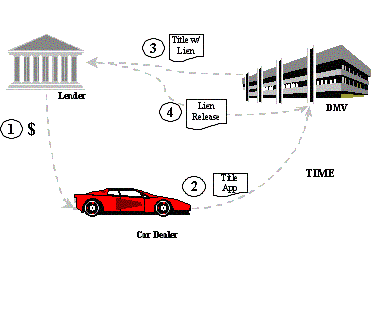
This is an application for automating a US-based financial institution’s automotive title department. It is a program for tracking titles, and managing car loans and their title information in co-ordination with the DMV (state motor vehicle authority). It tracks title department activities, monitors receipt of titles and manages exceptions. This desktop application connects through the Internet to the service provider’s server through MQ Series. The existing desktop application was converted to a Java based web application. This enhancement will enable lenders to access the application from remote locations through the Internet.
The communication of this application involves IBM MQSeries messaging system as the middleware that in turn communicates with the database server. The database is in MQServer, and MQMessages are sent to update/retrieve data. MQClient for Java is used to connect to the MQServer using MQSeries IP Address, QManagerName, ChannelName, Input/Output 'Q' Name and environment settings.
Technology
|
Name
|
Specification
|
|
Language
|
J2SE1.3
|
|
1. IDE
|
Java-Forte3.0 (EE)
|
|
Presentation Layer (Web Pages)
|
JSP1.2/HTML3.2
|
|
Server side Controller
|
Java Servlet2.3
|
|
Server side Model
|
Java Beans
|
|
Database connectivity
|
JDBC2.0
|
|
Web server (HTTP) for development
|
Apache1.3.22
|
|
Connector Module
|
Mod_jk.dll
|
|
Application server (Servlet/JSP engine) for development
|
Jakarta-Tomcat4.0.1
|
|
Version Control software
|
Microsoft VSS6.0
|
|
Java-Build tool
|
Jakarta-ANT1.4
|
|
Script Language
|
JavaScript
|
|
Testing Tool
|
J Grinder 1.6 / JUnit 3.7
|
|
Logging Tool
|
Log4j 1.2.4
|
|
Messaging Product
|
MQ-Series 5.0
|
|
Client Module Tool for MQ-Series
|
MQ-Series Client for Java
|
|
Operating System
|
Windows NT/2000
|
|
Database
|
MS-SQL Server 7.0
|
|
Web Browser
|
IE 4.5, 5.x, 6.x, Netscape 6.0.2
|
System Architecture
The below diagram explains the workflow of lien across different entities.
FRISK MANAGEMENT
Location: UK
Industry: Retail
Technology: TIBCO/Sun
Domain: EAI
Description:
This project involved strategizing the porting of code from Unix (Solaris 2.5) to Windows NT\2000 and Maintain Single source base. This project deals in porting of a banking application from Unix to Windows, understand the different OS specific library calls and replace the equivalent code on the target system.
Environment: UNIX (Sun Solaris) SUN C++ Compiler 5.3, Windows NT\2000 and VC++ and RogueWave, TIBCO, MQSeries
ASSET MANAGEMENT SYSTEM
Location: Singapore
Industry: Financial
Technology: Java/Linux
Domain: Web
This project was for an asset management group based in Singapore. We developed a portal carrying asset management features. This allows each user to create his own portfolio, select a Fund Manager from a list of Fund Managers provided, and assign a model to it. Models define how to use the fund in a portfolio. The Fund Managers update models. Users can either place an order for selling or buying shares directly to a broker or opt for re-balancing according to the model selected. Whenever re-balancing is done, the system raises an order sheet accordingly to buy or sell shares.
Technology
HTML, Java, Java Script, Java Servlets, XML, Apache Web Server, MySQL, Linux
CATALOGUE CREATION TOOL
Location: UK
Industry: Retail/Distribution
Technology: Microsoft
Domain: Web
This UK based client is a leader in furniture-specific application software. The project deals with creation of a new application – a Catalogue Creation Tool - that would provide a fast method for users to enter product information, associate prices and then publish the resulting catalogue to a portal.
Once the catalogues have been created, they can be sent to the portal engine. They can also be received from the portal, and the tool database will be updated accordingly. The native XML file format can be stored on disk for users that do not have access to the portal engine. To facilitate fast data load from existing data sources there are import/export routines to load elements into the tool. The tool will also provide a means of creating product/pricing structures for the existing Furniture Retail System.
Technologies Used:
VB.NET, XML, Windows 2000/XP, SQL Server 2000
CLINICAL LABORATORY INFORMATION SYSTEM>
Location: US
Industry: Healthcare
Regulation: HIPPA/CLIA
Technology: Microsoft
Domain: Client/Server
The application is a sophisticated laboratory information system that has advanced and custom-designed features and services as standard elements, including voice capabilities, image management and tumor staging. The application is a client-server application for complete case processing with CLIA compliance and HIPAA related security and privacy provisions. It is a proven system for case development and reporting, deployed in hospitals, private laboratories, clinics, group practices and other healthcare settings worldwide.
Our scope of work involved the conversion of the original SmallTalk application to the .NET platform.
Technology
VB.NET, MS SQL Server, Windows 2000, Crystal Reports for .NET, and Enterprise Architect (UML modeling and design tool)
CREDIT CARD PROCESSOR
Location: UK
Industry: Banking
Technology: Java/Sun
Domain: Web
This is a complete credit card processing application for a banking software company in the UK. This project also involves the conversion of the user interface from Unify’s Accell code (character based 4GL) to J2EE/JSP technology.
1.3.2 Technology:
JSP, Servlet, EJB, BEA WebLogic, Jakarta Struts framework
ENTERPRISE APPLICATION INTEGRATION USING TIBCO
Location: US
Industry: Retail
Technology: TIBCO/Microsoft
Domain: EAI
Description:
This project was carried out to develop adapters for various applications such as Clarify, Siebel, and Vantive for technologies like TIBCO. These adapters enable the applications to communicate with each other through a MOM.
Environment: Clarify 9.0, Vantive 6.0, Siebel 2000, VC++, MS SQL Server 7.0, TIBCO,
Rational Rose 2000 on Windows NT 4.0
ENVIRONMENTAL MANAGEMENT PROGRAM
Location: US
Industry: Technology
Technology: Oracle/Microsoft
Domain: Web
The Environmental Management Program has been designed to provide the user with detailed, graphical information about the asbestos risk at a given location or range of locations. The current project involves development of a web-based application that allows Guest Users to access the information through the Internet.
Guest users would be able to access the Application over the web through a browser with existing file data storage system in the server. The Named user and Admin user can make use of the existing application for adding/modifying the survey data.
Technologies Used:
ASP.Net using C#, Oracle 9i, Crystal Reports 8.5
FLEET MANAGEMENT SYSTEM
Location: UK
Industry: Retail/Distribution
Technology: XML/Oracle
Domain: Web
Aeromed is an online fleet management system for airborne ambulances developed for a critical care transport service that caters to patients in an emergency medical condition. The system involves interaction between aircraft/helicopter and multi-location ground units when there is a request for such a service.
This is a browser interface developed using a pure Java application with 5-tier flexible Java architecture for reduced coupling, which makes enhancement and redeployment a lot easier. Screens were developed using HTML/JSP, Servlets technology for the middle tiers and Oracle as the backend database.
This application incorporates three modules:
The Dispatch Module keeps track of data, time, date and geographical locations (from Yeomen Plotter). These data are transferred from the Dispatch Module to the next module (Flight Management Module) using XML.
Flight Management Module: This module is vital for air and ground stations. It consists of a real time transfer of information. A parser receives the transferred data from the Dispatch Module and gives graphical displays. XML is again used at this stage.
Aeromap Module: This displays the aircraft tracks and flight plans on a map.
XML is extensively used to transfer stored data to modules and to change the data to graphical format.
1.4.1 Technology
JSP, Servlets, Java Beans, XML, JRun3.0, Rational Rose, Oracle, WindowsNT
Gaming Management System
Location: UK
Industry: Betting/gaming
Technology: Microsoft
Domain: Client/Server
(A) Programming of a ‘Site Client’, which embeds a web page, loads ActiveX games, and securely connects to Remote Game Server
Technology : VC++, ATL, GDI , ASP, Web Browser Controls, Browser Helper Objects,
HTTP XML Server Side Objects, WTL
Description :
The gaming system is for network casino games where a Client Pad having an Embedded Web Browser securely authenticates players and allows players to play online casino games. It has a game server, with components spanned across two servers, viz. - Fun and Real Server. The project involved modification of the Client Pad (Site Client) to incorporate the requirements of security and messaging architecture.
Every game in the framework is composed of a multi threaded COM server and stub, which communicates through a proxy installed in the user machine to an active client which provides game UI. A connection oriented security system with asynchronous call back is used for client server communication. The project also included implementation of web browser control and distributed messaging architecture. Furthermore, we also designed and developed manager classes like Display Manger, Display Element Mangers, Advise Managers and Sink Managers.
(B) Online Casino Games (Roulette, Slots And Blackjack)
Technology : VC++, ATL, GDI , ASP
Description :
We designed and developed online casino games for distributed multiplayer casinos. This comprised of design and development of Roulette, and design and code review of games like Slot and Blackjack, to work with an established gaming framework in the UK. The work included design of the screens and coding of certain modules, code walkthrough, unit and integration testing, packaging and delivery. Microsoft VSS was used for version control.
(C) Betris
Technology : ASP, VB, XML, WAP, VC++, MS SQL Server, ATL 3.0 (COM),
Windows 2000
Description :
Betris is a variation of the popular Tetris game incorporated to a gaming pad. It is a low stake gaming software, and is part of an online casino gaming site. It employs three-tier architecture to split the logic among different layers for ease of maintain and expandability.
The project contains 4 modules - Server, Client, Proxy/Stub and Log. The game server is a multithreaded COM server, which runs a single instance, monitors and controls all the connected games. A proxy/stub dll takes care of communication between server and connected game clients. A downloadable WIN32 client application implements the user interaction routines and the actual game logic. SQL Server is used as a storage media for game state and other related parameters.
The client communicates with the server using the proxy stub through a framework asynchronously. In the online real play mode, all the bets are placed through registered accounts funded with real money. Rather than creating both an offline and online version of the game, the framework is designed to use the same game components for both the client and the server. The communication between the game components and the framework is achieved via interfaces. As the communication between the client and server is asynchronous, the game specific interfaces are designed to operate asynchronously.
The Game Server and Game Pad (Client Side) have been developed in VC++. The Game Pad contains an Internet Explorer object, which displays the web pages. ASP, HTML, DHTML and XML have been used for the web part of this project, and MS SQL Server is used as backend.
The user and game related information is managed through the web pages. We developed a separate web application for game configuration and reporting.
HERE-2-LISTEN
Location: US
Industry: Healthcare
Technology: Java/Oracle
Domain: Web
Here-2-Listen was a premier online psychotherapy and counseling provider. The site offers access to a comprehensive selection of counseling and therapy services. It also offers personal online therapy that is more accessible, convenient, confidential and affordable than traditional person-to-person therapy. Here2Listen provides “community” features such as chat and message boards for users with similar needs and interests, web hosting for member web sites, free email, and moderated group therapy. This site provides services for professionals to manage their offline and online billing, scheduling, and patient records.
Our project team developed chat client extension, secured communication channel, authentication server, scheduler, billing, patient records, and offline billing modules, as well as the audio/video interface.
The chat module facilitates the client and provider to talk each other. The entire communication is secure with SSL (secure socket layer). The chat server was developed in C++ and the clients in Java. Chat server is connected to a database to store/receive information about the users of chat service and information about each chat session.
1.4.2 Technology
C++, Java, Java Servlets, HTML, XML, XSL, Java Script, Oracle 8i, Java Web Server, Windows NT
HIRE MANAGEMENT SYSTEM
Location: UAE
Industry: Retail/Distribution
Technology: Microsoft
Domain: Web
This project involves the design and development of a Hire Management System that supports the core operational business in the hire of temporary road services and ancillary services.
The major features in the system are:
Multi-lingual capability to support operations in different language zones
Multi-currency support for operations in different currency zones
Capability to do full contract costing and price/revenue analysis
Database design that provides the core of a complete MIS facility
Full transport tracking
Full stock movement tracking
Managing changes to logistics organization
Incorporating new services and brands with no or little rework
The major functions of the system are:
Maintaining organizational and contact structures/relationships
Creating and managing quotations
Provision to have credit account facilities
Creating and managing contracts
Arranging logistics of resources, to and from the client’s site
Managing ongoing contracts to off-hire and completion
Invoicing
Managing assets through provision of a FAR and stock management
Providing ‘management services’ including MIS and Marketing
Maintenance of information and structures within HMS
Dynamic website and corporate intranet
The application is being developed using ASP.NET using a 4-tier architecture with Data, Data Access, Business Logic and Presentation Layer making the 4 tiers. The Presentation layer communicates with business objects using .NET remoting, through a TCP channel. The presentation layer is a thin client. It communicates with the business logic layer by implementing a set of Interfaces. The Business logic layer communicates with the database through the Data Access layer and does most of the processing.
This layer is responsible for sending objects to the presentation layer in the required format, processing the objects sent back by the presentation layer, triggering Email alerts, creating Event records and other administrative activities. The data access layer hides the overheads in maintaining connections and other database specific issues. The data access layer, thus, effectively hides this implementation from the rest of the System thereby enabling the system to work well with SQL Server and other RDBMS. The 4th tier in the system is the Database layer.
This HMS has a provision for a Pocket PC module that provides an electronic platform for the receipt of job-related information. All transactions between the mobile application and the HMS system occur through the XML queue that is hosted at the server.
Technologies Used:
C#, ASP.NET, MS SQL Server 2000, ViaXML, Crystal Reports, Windows 2000
ISP MANAGER
Location: US
Industry: Technology
Technology: Java/Oracle
Domain: Web
This company in the US provides services to Internet Service Providers by transferring web data and objects across the world through their customized suite of software. The purpose of this project was to build an administrative system for ISPs. This product could be used to manage day-to-day operations and generate reports.
The administrative system database is centrally located to create and configure sub-modules, customers, users and privilege management. Necessary log and error reports are generated for all the data access and modifications in the database. All business logic is contained in the beans and JSP was used only for the front-end, thus separating business logic from the presentation layer.
Technology
Java, JSP, Servlets, Java Beans, HTML, JRun3.0, Rational Rose, IIS 4.0, MS SQL Server, Rational Suite, Rational Unified Process, JDBC 2.0, Oracle 8.1.6, Oracle Designer 6, JRun Studio 3.0, WindowsNT
LEGISLATIVE MANAGEMENT SYSTEM
Location: UK
Industry: Technology
Technology: Microsoft/Oracle
Domain: Web
The application is a comprehensive legislative tracking and information management system. It integrates the entire legislative process into an automated management support and tracking system. The system can track all actions taken on each legislative matter by any governing body and include individual votes, where appropriate. This information can be accessed through on-line display, printed reports or made available to the public over the Internet.
The original software is a VB-based desktop application used to automate the workflow of a legislative office. We involved in upgrading the application to the .NET platform
Technologies Used:
VB.NET, HTML, MS SQL Server and Oracle, .NET Platform
INTERACTIVE TV BASED SHOPPING CART
Location: UK
Industry: Media
Technology: Java
Domain: Web
This project was for a UK based client specializing in the supply of entertainment products. We developed an application that enables the customers (TV-Viewers) to shop the products from home using set top box. Customers would have to supply credit card and other details, which are sent to the web server across through a dial-up connection. The system uses SOAP messaging to exchange data between servers, which act as Agent and Manufacturer Databases.
Technology
|
Name
|
Specification
|
|
|
J2SE1.3
|
|
Presentation Layer (Web Pages)
|
JSP1.2/ Tag Libraries
|
|
Server side Controller
|
Java Servlet2.3
|
|
Messaging Protocol
|
SOAP Messaging
|
|
Data Exchange
|
XML
|
|
Front End for TV application
|
XBML (X-Browser Mark Up language) / SDL (Service Definition Language)
|
|
Web Server
|
Tomcat Web server 4.0.3
|
|
Operating System
|
Red Hat Linux 6.2,Win NT
|
|
Database
|
SQL Server 2000
|
|
SDK for TV Applications
|
Open TV SDK
|
|
Hardware
|
Set Top Box + TV
|
System Architecture

Description
The user (TV viewer) sends a HTTP request through a set top box (STB) using a dial-up connection. This request is being routed to JSP via Controller Servlet. The JSPs will interact with the Shopping Cart module to produce the final output in SDL format, which will be rendered to the TV using the X-Browser and the STB. If the requested SDL page is not found on the STB, it will provide a dial up connection to the web server and fetch the requested page via the return path.
Online Casino Game testing
Location: UK
Industry: Betting/Gaming
Technology: Microsoft
Domain: Testing
The Customer
The customer is a specialized provider of sophisticated and innovative software games and services in the US and UK. Some of the world’s leading Internet casinos.
The Challenge
The challenge was to test the product compatibility on multiple platforms like windows 98, 2000,NT, XP and Netscape.
The Solution
We worked on the gaming system and developed testing strategies for multiple release of the product. We developed the test suite for individual games. Each test suite comprises of 5 test plans and 60 test cases. The test cases are automated with Bot Robot. Regression test is performed using Bot simultaneously on 10 -15 terminals from various locations. This ensures that every new release of the product doesn’t have any adverse impact on the core functionality of the software. The team also performs white box and black box test for the release of new games.
This has allowed us to greatly reduce product defects before reaching the field.
READ BILL COLLECT (RBC) SYSTEM
Location: Indiana
Industry: Utility
Technology: Microsoft
Domain: Web
The goal of the RBC is to support sub-metering and sub-billing of the tenant/occupant accounts in multi-location premises where the site is master metered for some or all of the utilities and the site owner wants to allocate the overall utility costs across the individual tenants in a fair and equitable way.
The scope of RBC is to establish tenant/occupant customers and associate these occupants with the sub-premises that are usually represent units in a multi-premise building or property. The RBC application allows occupants and premises to have accounts established for the billing and accounting of electric, gas, water and/or other commodity services. These services may be metered via telemetric sub-meters or the usage for the master meter may be allocated to the individual premise units using allocation parameters and algorithmic calculations.
Technologies Used:
C#, ASP.NET, VB.NET, MS SQL Server 2000, IIS 4+
School Administration System Testing
Location: US
Industry: Education/Research
Technology: Microsoft
Domain: Testing
The Customer
The client is a premier provider of school administrative software for educational institutions in the United States and has established operations in over 60 countries worldwide.
The Challenge
The challenge was to test shrink-wrap product on multiple platforms.
The Solution
We has been closely involved with the design of the product. We has developed the complete testing methodology for the product. Integrated testing suite consisted of 8 test plans and over 500 test cases. Further, approximately one third of test cases were automated by use of scripts resulting in time and cost savings
SEC REGULATORY COMPLIANCE SYSTEM
Location: US
Industry: Financial
Technology: TIBCO/Oracle
Domain: EAI
Description:
The project involved developing a compliance system to enable better compliance checking for client's brokerage business with US SEC regulations. It does real time processing of market data and Reuters data to generate alerts. Also, it does intelligent gathering of information from trade and order data to generate compliance reports for insider trading, chinese wall, booking anomalies, trace reporting, and other compliance reports.
Environment : Tomcat 4.1, JDBC, Servlets/JSP, Oracle 9i, BusinessObjects, Webintelligence, Reuters SFC, Tibco Rv
RETAIL DATA WAREHOUSE
Location: US
Industry: Retail/Distribution
Technology: Microsoft
Domain: Data Warehousing
This project was executed for a client in the US running a chain of retail stores. The client was looking to implement data warehousing so that the company management would be able to analyze sales data and other information
The solution was to implement a web enabled OLAP system that would provide all the reporting and forecasting requirements for the company with the ease of accessing it over the web. Microsoft SQL Server 2000 and Analysis Services 2000 were chosen for the database platform.
The solution necessitated a database design that could fulfill all the reporting requirements within strict performance parameters, and include centralized calculation of complex key performance indicators (KPI’s) across many dimensions. A robust data transfer process was also necessary, to ensure accuracy of reports based on data from multiple sources. This included not only the design and implementation of the database solution, but also the implementation of administrative procedures, supply of complete project documentation (including recommendations for future expansion and development), and provision of customized training for client’s administrative and development teams.
Key Performance Metrics used for validating the Data Warehouse design.
|
Metrics
|
Description
|
|
On-time delivery for Remote Order
|
Actual date minus customer due date
|
|
Turn around time –all customer orders (goal - 2 days)
|
Ship date-receipt date
|
|
Back log trend Order
|
Orders received but not shipped yet
|
|
Volume of Orders
|
Weekly / Shipped / Received
|
The solution involved
Designing OLAP cubes and dimensions
Creating MDX expressions for all KPI’s
Creating the SQL-MDX query syntax and client logic - to allow customization of user reports
Designing the data cleansing and data realignment processes
Building the data warehouse.
Building data marts.
Designing cube aggregation design and processing strategies
Configuring MS SQL Server 2000 and Analysis Services according to the application’s performance requirements
Integration into existing web application to view reports.
Architecture
ETL Strategy
The ETL process moves data from the source systems and populates the data mart with data. The data will undergo several levels of transformation to conform to the standards of the data mart dimensional model.
The following process segments had been identified:
Delivery Engine:
A Windows 2000 service program would sample the source database for any new transactions fed to it. On identification of a new transaction, server program would compose a MSMQ message object with the relevant transaction information and dispatch it to a disconnected MSMQ configuration. This configuration would provide greater scalability and availability in the system through disconnected message processing. Message Queuing technology enables applications running at different times to communicate across heterogeneous networks and systems that may be temporarily offline. Message Queuing provides guaranteed message delivery, efficient routing, security, and priority-based messaging.
Transformation Engine:
Eliminates junk data, cleanses invalid columns and does custom lookups that will facilitate transformations. The transformed information would be then fed to the target tables. The process involves writing the cleansed data to a flat file and then read by a DTS package to feed to the target tables. This allows high-speed data loading from text files into SQL Server tables.
Target Data Load Target fact and dimension tables will be created on SQL Server 2000 database residing on a Windows data center server. The target system tables will be organized in star-schema bus architecture.
PDA BASED APPLICATION FOR SCHOOLS
Location: US
Industry: Education/Research
Technology: Microsoft
Domain: Web
This application is part of complete school automation software. A disciplinary module was developed for Pocket PC. Guidance counselors in schools use this module to enter disciplinary data for a student. At any point of time the user can pull up a student’s data by scanning the ID card of the student and verify the schedule of the student. This would indicate where exactly the student was supposed to be at this point of time. If the student is in violation of the schedule then the user could use the form to enter the violation committed by the student.
The forms were developed using VB.NET the forms contained data-bound controls using ADO.NET. The application supported both online and offline access of the data based on the wireless network capabilities of the school. For offline access a desktop VB.NET application was developed to synchronize the data when required.
Technologies Used:
. NET compact framework, SQL Server CE, VB.NET
NEXTGEN MIDDLEWARE INFRASTRUCTURE
Location: US
Industry: Technology
Technology: WebMethods/Ariba
Domain: EAI
Description:
The NextGen middleware infrastructure enables deployment and delivery of Internet Commerce applications and solutions intended for the client’s customers and partners. The goal of the NextGen project is to provide a single ordering engine for client such that the current ordering and commerce applications as well as the new applications that client will develop in future are completely de-coupled from the presentation and message interchange protocols. A successful realization of the above goal would enable the business applications to rapidly adopt with ease the new technology standards and solutions.
The following middleware services will be provided by the NextGen middleware infrastructure:
Authentication Service : This service authenticates the user who sent the document and verifies the identity of the user. Various service handlers implement different challenge-response strategies ranging from simple user-password to digital certificates.
Database Service : This service provides database connection pooling to business and middleware services.
Translation Service : This service enables de-coupling of presentation aspects and data formats of the information that is either received or generated by the business and/or middleware services.
Session Management Service : This service identifies a session in progress from the requesting document or creates and maintains a new session for the request.
Access Control Service : This service exercises access control policies on a per message basis that are inbound. Entitlement Service: This service allows the business services as well as other middleware services to retrieve entitlement information associated with a given user or a role.
Logging Service : This service allows the business services as well as other middleware services to customize logging behavior of the inbound and outbound messages.
Messaging Service : This service provides a simple framework for the different services to interact both synchronously and asynchronously amongst each other.
Exception Handling Service : This service handles exceptions as raised by other services.
Environment: JSP, Servlets, EJB, Corba, TIBCO, CXML, RosettaNet, Ariba buyer 7.0 , webMethods and Oracle 9i
LOGISTICS MANAGEMENT SYSTEM
Location: US
Industry: Pharmaceutical
Technology: Oracle/Microsoft
Domain: Client/Server
We have developed an integrated application for a pharmaceutical company in USA. They had a FoxPro based system to cover Sales, Purchase, Inventory, Production, Quality, Routine Chemical Analysis, Microbiology Tests, Stability Studies and Financial Accounting. We developed a fully integrated application based on Client Server architecture using the .NET framework.
Technologies Used: VB.NET, Oracle 9i
LEGAL DOCUMENT MANAGEMENT SYSTEM
Location: UK
Industry: Service
Technology: Microsoft
Domain: Web
This product is used to organize intellectual capital (inter departmental administration & document management) within a medium sized law firm. The objective of this project is to gradually turn this product into a completely generic application that can be customized at the user level to work in any organization.
Company Site:
There are three major functionalities in this site viz.,
Document Management
Managing FAQ
Managing Employee Information
Document Management:
Here document hierarchy is maintained in three levels viz.,
Department
Category
Documents
All documents are organized by Category and a group of categories makes a department. A document can have internal documents as well as external sites as references.
Maintaining FAQ:
Using a user entry form, users can create a FAQ, as well as refer an internal document or an external site to the FAQ.
Managing Employee Information:
All employee information is maintained in this module. Admin user can add or edit employee’s information for any department. It is also possible to see employee’s profile (with photograph), as well as check attendance. We involved in migrating the original application written in ASP3.0 to ASP.NET.
Technologies Used:
ASP.NET, ASP, MS SQL Server
Hospital Mangement System
Location: Dubai, Middle East
Industry: Healthcare
Technology: Oracle/Microsoft
Domain: Testing
The Customer
The customer is a chain of hospitals located in Dubai and Sharjah, having bed sizes of more than 100 beds.
The Challenge
The challenge was to test the user friendly and scalable application, which has been continuously enhanced with new features to meet the user requirements.
The Solution
We defined the test strategy for an integrated, comprehensive and highly customizable client-server application, developed using Visual Basic 6 and Oracle. For the latest release of the product significant number of test cases has been created with 9 test plans to cover the complex functionality of the software. Apart from the functional testing, emphasis was on the usability testing of software. The inputs from usability testing resulted in complete redesign of user interface with the provisions for the hot keys.
This enables us to provide software that meets our customer needs with out compromising on quality.
HIPAA IMPLEMENTATION USING VITRIA BUSINESS WARE
Location: US
Industry: Healthcare
Technology: Oracle/Vitria
Domain: EAI
Description:
The objective of this project was HIPPA implementation using Vitria business ware. It involved translation like 837, 834, 270, 276 etc and to map the BCBSMN EDI translations using Vitria Business. And also Design and Implementation of custom Connection models, using standard Vitria flows, Design and Implementation of Business models, using Automator and Connection models.
Environment: Vitria BusinessWare, Java, Jbuilder and Oracle
|
 |
| Testimonials |
| "In dealing with firms for over 30 years, DataTransit was the only one I ever dealt with that brought the requirements to me in a matter of hours. These guys know how to keep your business!" |
| William Marshall, CIO, GCS |
| ….read more |
|
 |
|
|
|
| Views |
| "Inside Outsourcing in India" - by Stephanie Overby (source:CIO) |
| 10 Commandments for Outsourcing to ensure that a win-win situation is guaranteed |
| Fall Guy: US Immigration and myth of offshoring: by Gary Endelman |
| ….read more |
|
|